
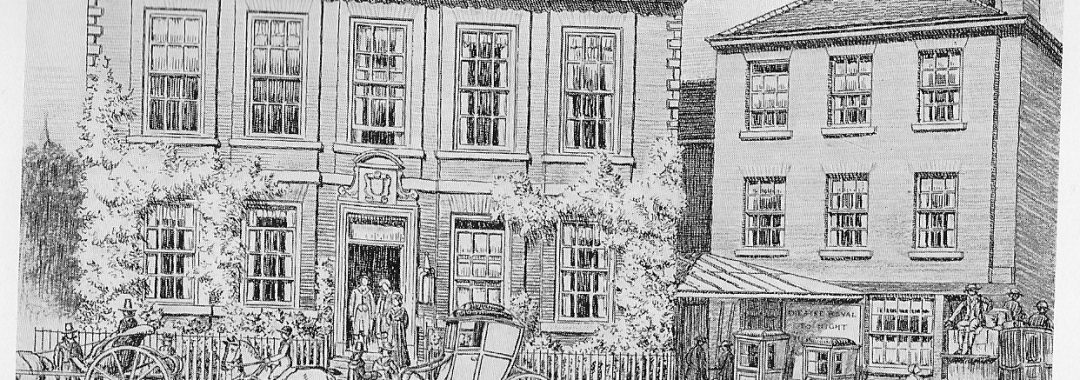
In the 18th century audiences at ‘country theatres’ did not always sit quietly and allow the actors to perform, and in the mid 18th century the ‘mania with theatre audiences’ was the singing of ‘God save the King.’
“It became a perfect mania with theatre audiences, who not only sang it once but half a dozen times during the evening, thereby holding up the progress of the play. It was quite a common occurrence for young bloods to jump from the stage-boxes on to the stage, insult the actors and lead the singing. The practice ….. was stopped by putting a row of iron spikes in front of the boxes and also at the corner of the stage near the proscenium.
The probable reason for the popularity of ‘God Save the King’ was that it had only recently been written. It was composed by a Yorkshire man, Henry Carey, who sang it for the first time in its present form as our National Anthem in 1740.
When John Philip Kemble was playing the part of Teribazus in Zenobia at York on April 13th 1779, a lady of position, accompanied by some officers of the militia, occupied the stage-box. She loudly expressed her disapproval of the play and so annoyed Kemble that he declined to continue acting until ‘that lady’ pointing to the offender, should cease her conversation.
The audience in general took the actor’s part and hissed the lady out of the theatre. The incident, however, did not end there, as the officers ‘went for’ Kemble the following day.
On May 12th, 1791, when a performance was given at York for the doorkeeper’s benefit, the last item in the bill was ‘The Conjuring Song’ by Miss Reynolds. A cake, a leg of lamb, and a lawyer in a sack, were conjured in consequence of the words. The audience demanded an encore, but the singer, feeling the absurdity of singing to charm again the cake and leg of lamb on to the table, and the lawyer already out of the sack, retired off stage. The curtain was rung down and the members of the orchestra left the theatre.
Instead of having the desired effect, it made matters worse, Tate Wilkinson who appeared on stage to the expostulate was saluted with a variety of candlesticks, branches, and flaming candles thrown at his head, with many cries of ‘knock the insolent fellow down’. The affair did not end until the band returned to their places, the song had been re-sung, amidst loads of grease, broken brass arms, etc., and the whole company had complied with the humiliating demand to ask ‘pardon’ from the audience.”
Grundy Heape – Georgian York (1937)
This article was first written in PastSearch Newsletter Issue 24 – December 2014.